At Thingtesting, everything we recommend is independently reviewed. We may earn a commission on purchases made through our links.
Thuy Nguyen Wants You to Try Breathing Like You’re On a Vietnamese Dancefloor
Herbal inhalers are popular across Asia, where they are used to liven the senses and fight fatigue. Now, Thuy Nguyen is bringing them to the US with AN ORI

Image: AN ORI
Thuy Nguyen was on a dancefloor in Hanoi when a friend passed her something to sniff. She inhaled. The first hit was sharp and cooling, and then, as it worked through her system, a calming sensation settled her into the noise and movement around her.
What her friend had given her was a small plastic herbal inhaler, the kind sold at pharmacies and 7-Elevens for around 45 Thai Baht (approximately $1.30) across Thailand. This scene took place in 2021, just as pandemic restrictions had lifted in Vietnam, and Nguyen — who grew up in Hanoi before moving to the US for college — was back home for the first time in years. The club scene was distinct from that of New York, and she learned that these small, unassuming inhalers had become popular accessories on dancefloors across Asia. “I found it so radically wholesome,” she says. “I thought it was a really amazing idea to be able to practice wellness within this space.”
Now she is hoping to switch US shoppers on to the ritual of herbal inhalers with her new brand AN ORI, which launches today.
Herbal Remedies, Reimagined
The inhaler Nguyen’s friend shared with her is ubiquitous across Thailand, where mass market brands like Hong Thai pack menthol and camphor into cheap, green plastic pots with screw caps. The closest US alternative would be something like a Vicks VapoInhaler, although in Asia they are used not only for congestion but whenever a jolt to the system is needed to feel more alert.
Nguyen, who is a freelance creative director whose clients include YSL Beauty, Swarovski and Balmain, says she loved the ritual of using the herbal inhaler, but found the cheap plastic packaging unappealing, and wondered if the scents could be improved.
AN ORI’s inhaler is housed in a wooden, egg-shaped vessel, hollowed out and sealed on the inside with a slick of natural beeswax, to stop the scent from the herbal pouch contained inside escaping through the wood. “An object you touch a lot by hand should feel intimate,” says Nguyen. She had explored other natural materials — limestone and metal — before settling on wood, which she says carries warmth in the way other materials don’t. Even the herbal pouch inside the pot is made with organic, medical-grade gauze rather than plastic. Nguyen says getting the wooden egg to work as she had first imagined, from the beeswax lining to the wooden grooves that allow the lid to twist on and off without getting stuck, took the best part of two years to go from prototype to finished product.
The scent inside is built around a tightly sourced list of ingredients. Natural menthol from India to deliver a cooling, calming hit that’s not as harsh as the synthetic menthol Nguyen also tested. There is lemon peel from Italy, patchouli from Indonesia, and the remaining botanicals are sourced locally within Vietnam. AN ORI’s signature scent note is wild mountain chrysanthemum, a yellow flower that blooms once a year in the mountains of Northern Vietnam, near the facility in Hanoi where AN ORI makes its products. Nguyen describes the scent as “elevated”, somewhere between herbal, floral and medicinal. Each AN ORI inhaler costs $44 and lasts for anywhere between two and six months, depending on use, according to the brand.
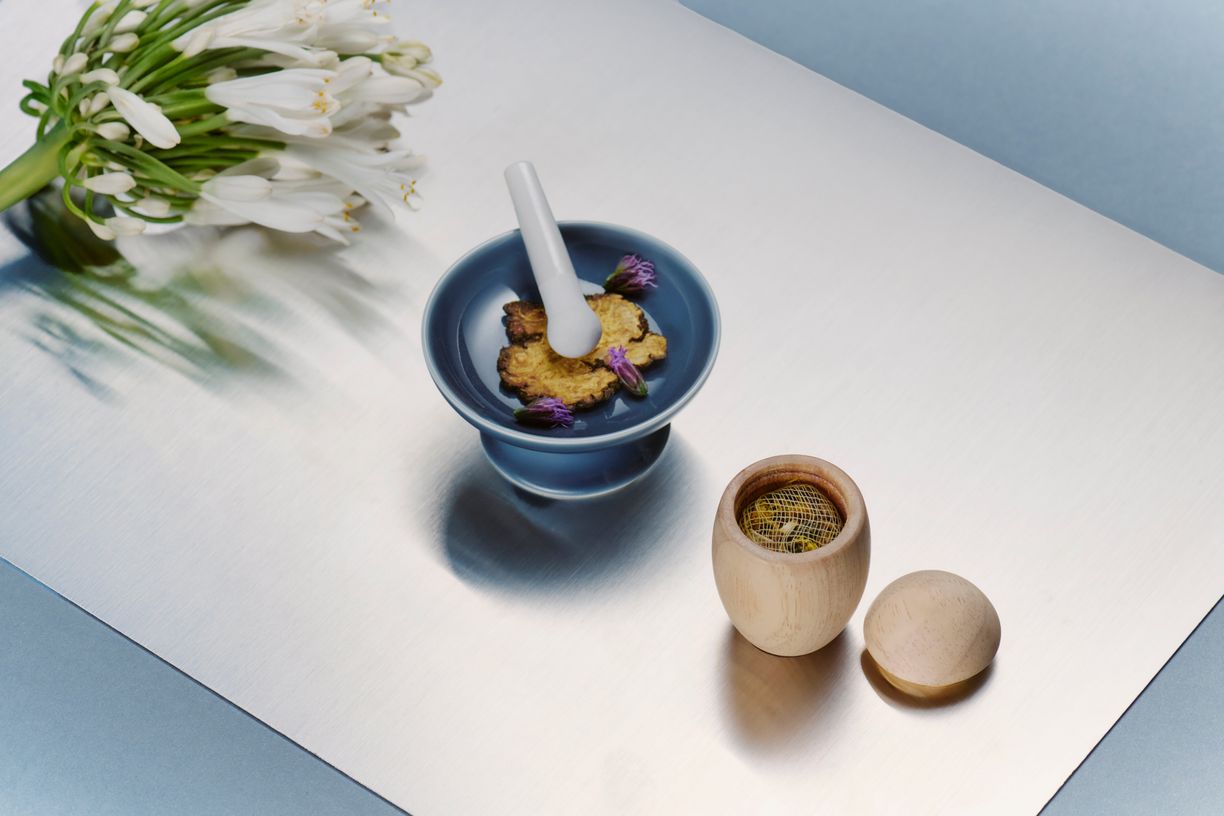
Image: AN ORI
From the Dancefloor to the Desk
AN ORI is the latest example of a product launching in a fast-growing wellness category, breathing. According to Grand View Research, the global breathwork therapy market was valued at about $1.3bn in 2025 and is projected to reach $3.4bn vy 2033, growing at a rate of nearly 13% per year. There are now programs teaching breathing techniques in schools and corporate offices, people are wearing nasal strips out in public and using breathwork apps, and home devices to improve air quality and add scent. “Breathing is the most human thing we do,” says Nguyen. “We all do it.”
The scenes AN ORI is targeting are different from those where Nguyen took her first herbal sniffs. When asked how she expects US consumers will incorporate a herbal ritual into their daily lives, Nguyen talks about taking the inhaler on planes and into saunas, in addition to, of course, the occasional dancefloor. She also hopes people will reach for it in more mundane moments like in between meetings, after receiving a stressful email, or mid-commute. Nguyen's belief is that people have an innate desire for nature that doesn't disappear when we move away from it. “We just happen to live in a city. We were born in nature, and that doesn't disappear.”
Nguyen says these are exactly the sorts of moments throughout her working life where she has needed rebalancing. Early in her career as a creative director, Nguyen worked with an executive coach who taught her breathing and tapping techniques to help manage pre-meeting anxiety. “It does calm your nervous system,” she says, although she is careful not to overclaim the abilities of AN ORI’s inhalers. “I’m not saying AN ORI is a tool to calm your nervous system, but it could be helpful. It’s part of that whole practice of connecting to your body, and connecting to your breath.”
“We are all busy, and we all have so much going on in life,” she says, reflecting on AN ORI’s journey from Hanoi’s frenetic dancefloors to New York’s bustle. “But maybe we could also take a deep breath.”