At Thingtesting, everything we recommend is independently reviewed. We may earn a commission on purchases made through our links.
The Problem With Dumbphones? Everyone Else's Smartphone
In a world that assumes everyone owns a smartphone, how do brands selling alternatives convince customers they won't be cutting themselves off from society?
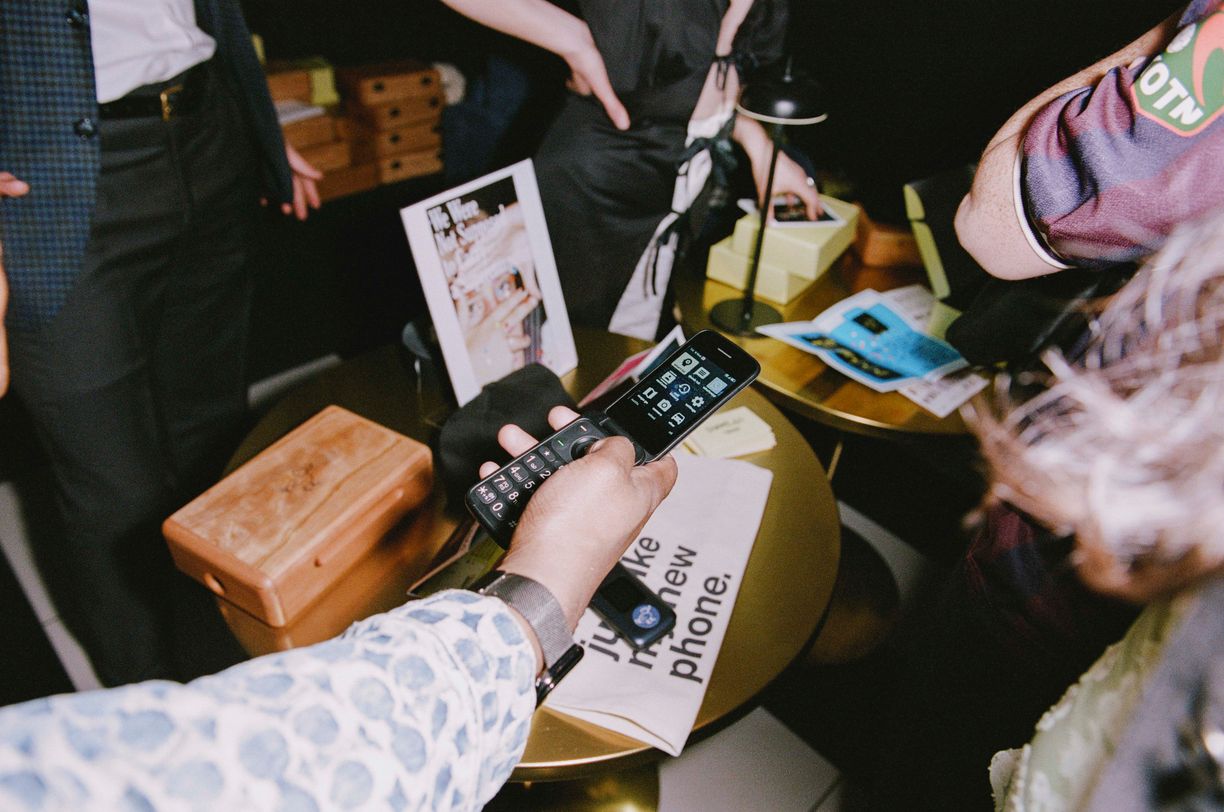
Image: Dumb Co / Jacques Morel
On May 1st, Dumb Co threw a party in New York City without mentioning it on social media. Instead, fliers went up, friends were invited, and people were told to leave their smartphones at the door. Five hundred people showed up, and the line to get upstairs was so long it spilled into the bar below. It was so popular, the venue had to stop letting new people in for a period. By the end of the night, Dumb Co had sold close to 100 of its low-tech flip phones.
“We ended up quite literally building new boxes for the phone on site,” says Afreka Ebanks, Dumb Co's director of brand and communications. “People were having such a good time. They were like: please, I need this phone.”
There are currently more than 4,500 people signed up to Dumb Co's dumbphone plan, where for $20 upfront and from $15.99 a month, subscribers get a TCL Flip 2 flip phone modified to sync with smartphones and run a limited range of apps including messaging, Spotify and Uber. The idea isn't to replace people's primary phones, but to give them a low-cost option for times they'd rather be free from their devices.
The appetite for lower-tech options like these is on the rise. According to YouGov, 53% of Americans want to spend less time on their phones. The reasons why keep accumulating: smartphones are linked to declining attention spans, rising rates of anxiety and depression, and a kind of low-grade disconnection from the people and places immediately around us. Gen Z — the generation that grew up most deeply embedded in this — is among the most concerned. “I think they're just really fed up,” says Joe Hollier, co-founder of Light, which makes the Light Phone. “It doesn't make them feel good.”
What Makes a Dumbphone?
The smartphone is a largely selled category, with each model ticking a uniform set of boxes regardless of maker. What the antidote looks like, however, is not yet agreed on, and so brands working on alternatives occupy a wider spectrum. At one end is a straight-up return to basics: like what Dumb Co is doing, or Nokia's 3310 reissued for nostalgia seekers who want something truly stripped back. At the smarter end are models like the Light Phone or Sidephone, developed specifically for a world already given over to smartphones, with the goal of providing necessary utility without the distractions that keep people glued to their screens. Wherever they sit on the spectrum, though, all these makers have run into the same finding: too dumb doesn't work. For most people, group chats live on WhatsApp, nights out end with a ride-hailing app, and getting around on the daily requires Google Maps. These things are hard to give up.
“We're not purists,” says Ebanks. “We're not anti-tech people who tell you to throw away your smartphone.” The apps available on Dumb Co's flip phones — Uber, WhatsApp, Spotify, Microsoft Authenticator — were chosen based on feedback from Month Offline, the company's 30-day smartphone detox program, which currently runs across around 10 US states, with more locations to be added.
Light Phone’s founders met at a Google incubator program in 2014, where they were tasked with building apps that were as “sticky” as possible. “The business model at hand is the attention economy,” says Hollier. “That felt antithetical to our actual happiness as users.”
In response to that experience, Hollier and Kaiwei Tang got to work on a new device that wouldn't be constantly fighting for users' attention. The Light Phone III, their latest model, is designed to be a full-time primary device: repairable, built to last five to 10 years, with a growing set of tools — maps, directions, texting, hotspot — added incrementally based on user feedback. The phone costs $699. Unlike Google or Apple, Light can't subsidise hardware through other business lines — so that, Hollier says, is what it has to be.
The idea behind both approaches is freedom: users of smart devices should have an easier time deciding how much or how little they need. Both have also noticed a growing interest among parents, wondering what their child's first phone should be, or worried about what smartphones are already doing to their children. It's a concern that's increasingly reflected in legislation — the UK, where Dumb Co plans to launch later this year, is among several countries exploring bans on smartphones in schools.
Sticking Points
Even with these efforts, sticking with a dumbphone can be complicated, as Kelsey Osgood, a writer and mother of three based in New York, has found. Osgood had a dumbphone for nearly two years, from early 2018 until just before the pandemic, when her dumbphone broke.
Looking for a replacement, Osgood realised the world was now built around the assumption that everyone owns a smartphone. Group texts were arriving garbled on her flip phone, and when she replied her messages would be sent to each person individually, making conversations disjointed. Parking apps, digital tickets and two-factor authentication codes all required something smarter. “The most annoying thing about having a dumbphone was that nobody assumes you have one,” she says. Even her son's school required daily digital health checks through an app, which parents couldn't opt out of. “I had to do it on my computer so that I could get in the car,” she says. “That was a barrier to me being able to move quickly.”
She now has an iPhone, even though she still finds the tech encroachment frustrating. “Sometimes it is easier,” she says, referring to apps she uses daily. After a pause, she adds: “Or have I just been gaslit into thinking that?”
Friction is part of the point of owning a dumbphone, Hollier points out. He says users who made the leap before Light Phone had added a maps feature ended up grateful for it: they learnt their cities better, started noticing landmarks, and stopped being afraid to ask strangers for directions. “There are some really awesome things that happen when you take away things that you feel like you need,” he says.
Still, Light is pragmatic about meeting dumb-curious consumers where they are at. “Their grandma's on it. Their boss is on it. The bank is on it. It's ignorant or selfish of us not to try to meet people there, even though it's not the perfect solution,” he says. Light Phone will have a Signal tool available in July, and the company also plans to launch a developer program in September, which will allow third-parties to build and share their own tools (such as, the company expects, WhatsApp integrations) on an open-source basis.
This will be a test for the brand, given that, in theory, someone could choose to integrate exactly the kind of sticky social media apps Light was built to avoid. Anything entering the Light-endorsed public tool library will have to meet criteria around intentional use, user privacy, and an absence of infinite scroll, Hollier says. “We're the police of time and attention,” Hollier says, “not of whether Uber is morally justified.”
Rather than solve the infrastructure problem through software, Dumb Co's idea is to solve it with community. Month Offline cohorts have generated genuine friendships — people who met during the program and now do crafts together, play sport, or call each other on their flip phones. Some people on the Dumb Co team leave their smartphones at the office overnight, and taken up hobbies like piano. Ebanks says she’s reading more books than she has at any point since high school. “What we really want is for people to have a much more autonomy,” she says. “It's more about the lifestyle created from the phone than the phone itself.” The company's tagline — “your life is waiting for you” — sums up the ambition and the anxiety.
Osgood, meanwhile, has bought her eldest son a Tin Can — a device that works like a landline, connecting to other Tin Can users — although she asn’t set it up yet, because it requires yet another app. She's aware of the irony, just like she's also aware that, at some point, her children are going to ask why they should watch their screen time, when Osgood's own phone use isn't where she'd like it to be. “And they'll have a point,” she says.