At Thingtesting, everything we recommend is independently reviewed. We may earn a commission on purchases made through our links.
With Wit, Ex-AI Startup Founder Sandy Kwon Trades Software for Pea Protein
Sandy Kwon spent 15 years building tech companies. With her new protein brand, Wit, she's testing how that experience transfers to the world of physical products

Last month, Sandy Kwon sat down with the R&D partner for her upcoming pea protein brand, Wit, to taste the latest version (attempt number five) of a powder designed to be mixed with nothing but water. “We were like, holy bleep,” she says. “It really tastes like melted ice cream.”
Consumers can test that claim when Wit opens pre-orders in December and starts shipping its single-serve pouches of just-add-liquid shakes in January, in time for New Year’s resolutions.
This experience of tinkering with physical formulas and managing all the moving parts of a consumer launch — packaging, distribution, consumer marketing — are all new to Kwon, who has spent the last 15 years of her career in tech, most recently as the co-founder of Datalab, an AI company whose customers include Anthropic and ElevenLabs. Consumer packaged goods is a totally different business with different rules, and here Kwon is an outsider.
“It’s a completely different way of operating, building and scaling,” she says. “I’m very humbled by it.” Nevertheless, the tech CEO tendencies come through as Kwon describes building the brand at speed — a “sprint”, her old colleagues might say — to get from concept to launch, R&D included, in under a year.
Protein Problems
As a child, Kwon competed in Tae Kwon Do, earning a second-degree black belt, and as an adult her training has shifted to focus on health and longevity. She’s also lactose intolerant, which has made it difficult to find a protein powder that tastes good. Whey, the default for most gym-goers, is made from dairy, while the main plant-based alternative, pea protein, is typically gritty, clumpy and has a strong aftertaste. Kwon says she would add so much fruit and sweetener to her shakes that they stopped being healthy. “I would have to throw in the entire kitchen sink just to make it enjoyable,” she says.
When LLM chatbots arrived, her research moved from the kitchen and into AI-driven rabbit holes. “For better or worse, there’s a confidence that you develop when you’re working with LLMs,” she says. She learnt that while protein was being added to everything from peanut butter to water, the plant-based market had stalled. “There hasn’t been a lot of innovation in the last couple of decades. Plant protein powders have largely been left behind,” she says. According to Nutrition Business Journal, in 2024 whey protein accounted for over 55% of the protein powder market, while plant-based protein powder sales had fallen 3.7% since 2022.
Kwon figured that, as an outsider, she could bring a fresh perspective to the category. Her research also revealed a supply crunch for whey. As a byproduct of cheesemaking, whey supplies can only grow as fast as cheese production, which no longer matches up as demand piles on from GLP-1 users and protein-obsessed gymgoers. “This isn’t a resource that can just grow overnight,” Kwon says. Whey prices have climbed by as much as 250% as a result, according to Ever.Ag, creating what Kwon sees as an opportunity for a protein alternative, vegan or not, that tastes good and can be sold at a better price.
Wit's answer is still pea protein, but reformulated. It is sweetened with monkfruit and bulked out with oat fibre, with no gums or artificial flavours. Kwon says the latest version has around 150 calories and 27 grams of protein per serving. Getting the texture right has meant working through a long list of suppliers, since the way the powder is manufactured changes how it binds and blends with water. Her R&D partner, who Kwon says has extensive experience working with drinks giants, then modified the most promising one until it had the mouthfeel Kwon was looking for. “He’s someone that has seen innovation and progress in this space for several decades, and his excitement for what we’re building has fuelled my delusions quite significantly,” she jokes.
The packaging, a single-serve pouch with an internal shaker, is borrowed from Korea, where protein shakes are commonly sold this way. When Kwon went looking for them in a New York Asian grocer, she quizzed the shelf stackers. “They were like, they’re flying off the shelves. Last year they weren’t even popular, but this form factor is [now] taking off.”
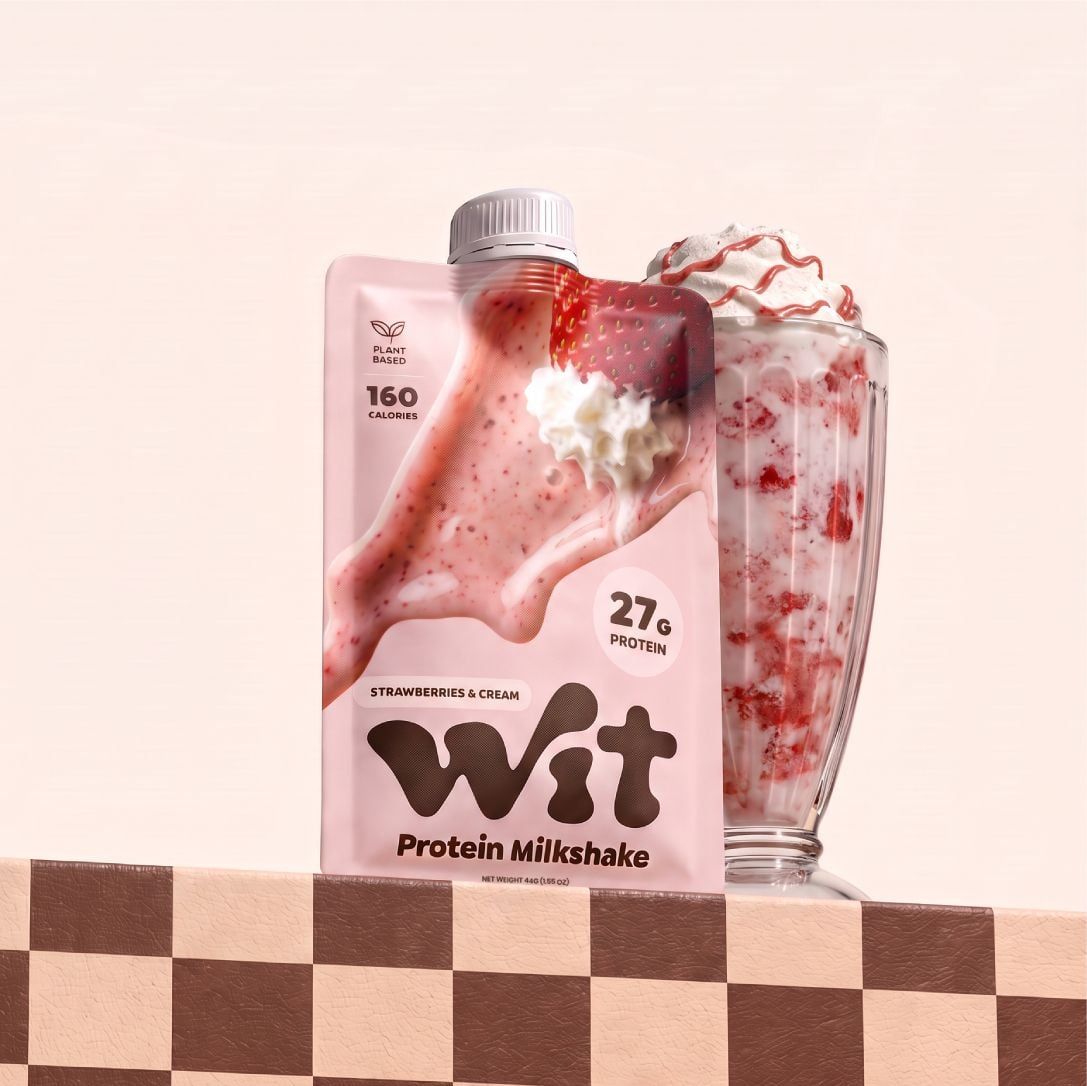
Image: Wit
Tech Meets CPG
Some tech founder habits translate neatly. Kwon says that as a non-engineer tech founder, she is used to being “the dumbest person in every room” at companies she helped grow to billion-dollar valuations, and she is applying that same license to research, ask questions and challenge industry norms to CPG. “I’m going to spend the extra hours doing research, learning everything I can about protein, so I’m not walking into the room without the knowledge I need.”
Kwon has raised venture capital before but is bootstrapping Wit, and instead of hiring the CPG operations consultant her advisors recommended, she built an “agent farm” of AI tools that chase suppliers and manufacturers, and send her a status update every morning. Kwon says it saves her several hours a day.
Other habits need challenging. Kwon was off social media for a decade, and describes her tech career as “talking to computers or people that are basically computers”. When a mentor told her she would need to develop a personal brand to make Wit a success, she started posting videos to TikTok and YouTube, and writing a Substack, building a following from scratch. So far, she has 500 subscribers to her newsletter, where she details her journey building Wit.
This has been harder than anything on the operational side, she says. “It’s very vulnerable and nerve-wracking, and [it has] forced a lot more inquiry about my relationship to myself than I expected,” she says. “Do I like how I look on camera, do I like the way I sound? I don’t have much of a following yet, and I know I’m going to have to earn it.”
The same goes for Wit, as it approaches its big test in January. Kwon, who spent years unable to find a shake she actually wanted to drink, is hoping strangers will have the same reaction that she and her R&D partner had in the lab. “I only hope the market feels similarly,” she says. “That I’ve been able to solve a number of problems that have existed in plant protein for a long time.”