At Thingtesting, everything we recommend is independently reviewed. We may earn a commission on purchases made through our links.
Can Tome Make a Prickly, Earthy, Unfamiliar Skincare Ingredient Go Mainstream?
Spongilla lacustris smells like something dredged out of a freshwater river. Tome says you should slather it on your face anyway
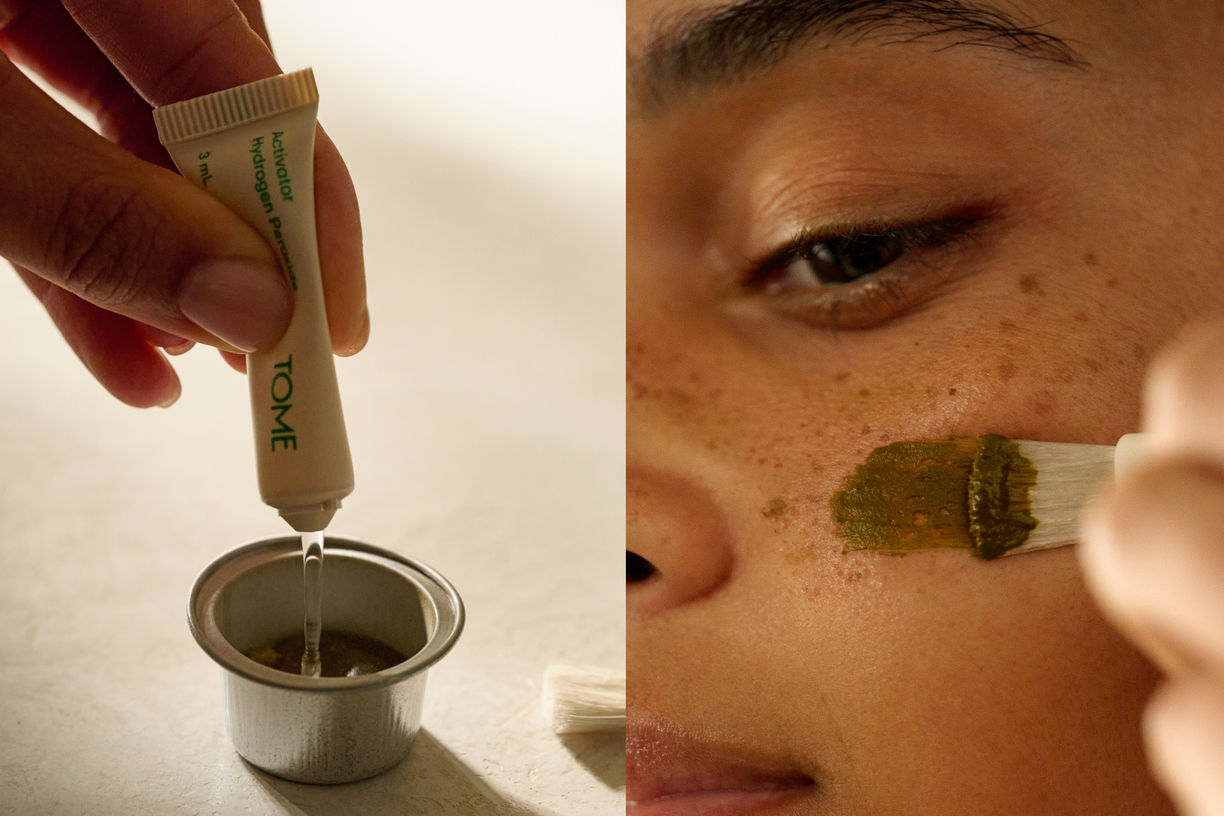
Image: Tome
Tome, a skincare brand that launched earlier this week, thinks you should slather a prickly sponge, harvested from freshwater sources in Eastern Europe, all over your face.
“It smells like you pulled it out of the river,” says Kyra Peckaitis, Tome’s VP of marketing, who is leading the brand’s launch.
She has her work cut out for her. Spongilla lacustris, Tome’s hero ingredient, is something few US beauty consumers will be familiar with, although it has a centuries-long track record as a traditional folk medicine. Badiaga, as the sponge is known in homeopathic circles, has been used across Europe and Asia for at least 500 years to treat things like bruises, scarring and blood circulation, although there is no robust scientific evidence for these treatments.
Now, for the first time, this particular sponge is being packaged up for use in at-home skincare routines.
The sponge contains thousands of microscopic, needle-like “spicules”. Spicule skincare already exists in Korea, where brands like VT Cosmetics and Medicube sell serums infused with marine sponge needles, which they say can trigger cell turnover when massaged into the skin.
Tome’s product, however, does not come in serum format but as a powder, containing nothing but the purified, ground-up freshwater sponge. Users are provided with a hydrogen peroxide activator that transforms the powder into a bubbly paste, that users can apply to the skin. This mechanism, Peckaitis says, “makes sure all the spicules are evenly distributed throughout.”
When massaging, users can expect to “feel the tiny little needles,” Peckaitis explains. “It’s spicy, like an intense exfoliation.”
Afterwards, the brand says users will likely experience some redness and peeling, similar to having microneedling or another procedure done at a dermatologist’s office, followed by skin improvements over time.
Life in the OTC Lane
This is also the debut consumer-facing brand for Dermata Therapeutics, Tome’s parent company. The pharmaceutical firm has been researching spongilla lacustris for more than seven years, says Peckaitis, and it is continuing to explore how this ingredient could be used to treat conditions like acne, psoriasis and rosacea.
Peckaitis credits Dermata founder Gerry Proehl as the one who identifyied the potential for this freshwater sponge ingredient to achieve mass consumer success. To launch Tome, the company pivoted from its usual model of developing prescription treatments in order to create an over-the-counter product. “He wants to bring it to as many people as possible and for it to be accessible,” she says.
The world of branding and selling directly to consumers was new territory for Dermata, and it’s how Peckaitis, who previously held senior marketing roles at direct-to-consumer diaper brand Coterie and salad chain Sweetgreen, ended up being hired. Her marketing philosophy is that brands should focus on doing more with less. “I think a lot of companies try to launch a lot of products to diversify and drive sales, and I think that confuses customers,” she says. “I really want to make sure that everything we’re doing is intentional.”
While most skincare brands launch with a full routine, Tome has just a single product, the “Foundational Treatment”, containing a single ingredient (the sponge — which Tome refers to by its trademarked name, “Bioneedle”). For the marketing team, the priority is to educate consumers on what Bioneedle is, how the product feels and smells, and the improvements users can expect to see to their skin over time. Each pack contains four treatments, with the idea that it gives users a chance to get a handle on the process. Peckaitis also says there is less downtime in terms of redness and peeling with each use. “The first time, you’re like, ‘how do I do this?’” she says. “It’s a bit unfamiliar. But hopefully your second, third, fourth time, you feel more confident.”
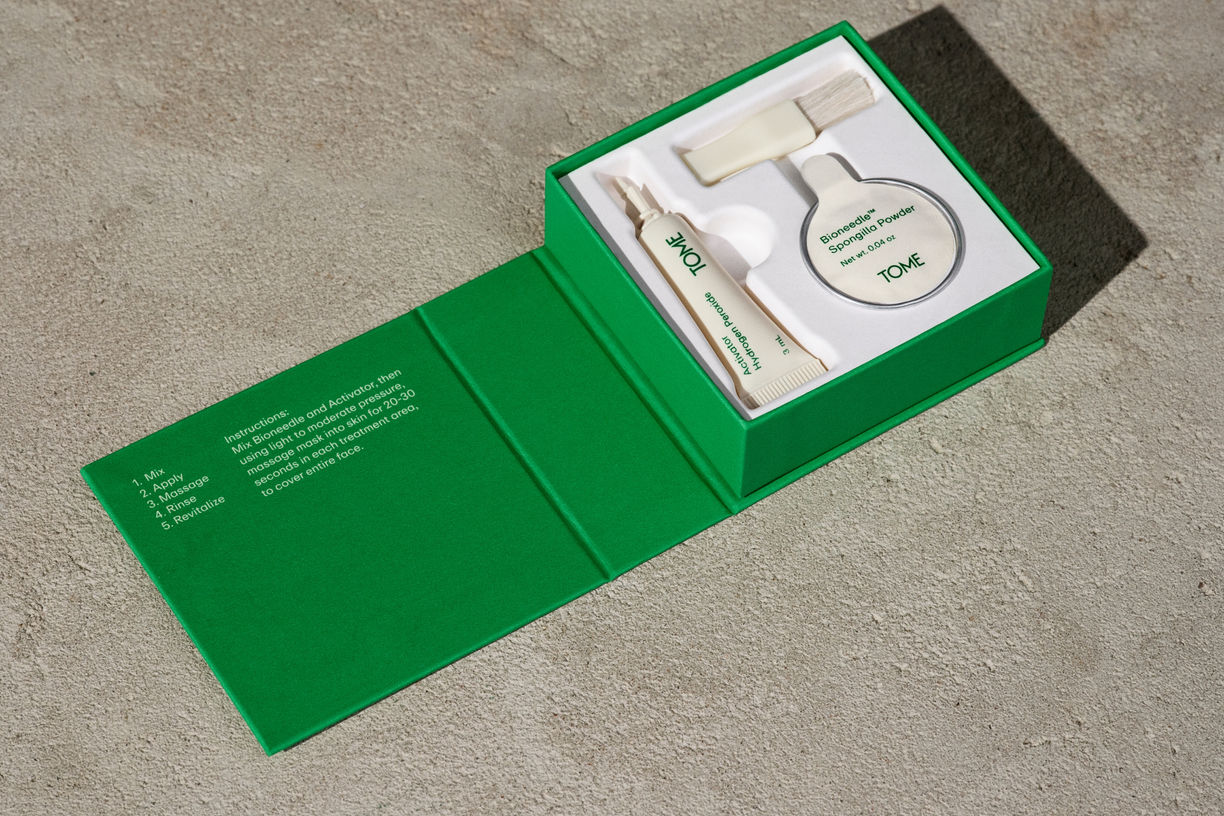
Image: Tome
Ancestral Evidence?
Another challenge is assuring customers that this new ingredient actually works. On its website, Tome talks about ancestral wisdom meeting modern science — presenting itself as applying pharmaceutical rigour to the anecdotal realm, and reengineering a centuries-old natural ingredient so that it’s clean and safe for home use.
But while the centuries of use are real, the decades of clinical data that already exists to back the launch of a more familiar ingredient like retinol or niacinamide isn’t yet there for this particular river sponge. “There’s not a lot of recorded data on the folk medicine piece of this,” Peckaitis admits. “There aren’t studies from the [formal] medicine standpoint.” Dermata is currently in the process of running its own studies, and the Tome team says data will be ready to publish soon.
For now, Tome is recommending that users think of the Foundational Treatment in roughly the same way they’d treat a peel or in-office microneedling session, only with a bit more regularity. Peckaitis says the treatment can be used as often as once a week, and that users should skip other actives like retinol and physical scrubs in the days either side of using it. The team will also be watching to see how users integrate Tome into their wider skincare routines, and if it replaces any of their regulars. “Do you need to be using retinols and scrubs every day if you’re using this product once a month? I can’t wait to see what people say,” says Peckaitis.
Whether shoppers will try this novel product depends on their individual tolerance for being at the cutting edge of what’s new in skincare. Tome’s own team knows it is asking a lot. As skincare products go, this requires consumers to try out a quirky process, an unfamiliar smell, a prickly sensation and at least a bit of redness. Peckaitis, who describes herself as a sophisticated skincare customer who is happy to experiment with new things, hopes the results will speak for themselves. “I tried it and I was like, whoah, this is crazy. This is cool.”