At Thingtesting, everything we recommend is independently reviewed. We may earn a commission on purchases made through our links.
FOUNDER INTERVIEW
Cherry Golf Club is redefining women’s golf.
Women are the fastest-growing segment in golf. The products haven't caught up. Cherry Golf Club, part community, part brand, is trying to fix that.
When Ivee quit her tech job in June 2025, she wasn't looking to start a brand. She was looking for air. "I wanted to find something that would help me find myself again," she says. "My tech job was so stressful. I was just missing being in nature."
She started going to parks, open green spaces, eventually golf courses. But she was living in New York and didn't know anyone who played. So she posted a TikTok. "Do any girls in New York want to play golf together?". Hundreds responded.
"I was just so shocked," she says. "I didn't know such a big community was interested in golf, especially so many girls."
@ivgolfs girls in nyc who play golf or want to learn!! lets go play together :) my dream is to build a girl golf community in nyc 🥹 #girlsgolf #girlswhogolf #nycgolf ♬ Real Love Baby - Father John Misty
The gap in the market
Women now account for roughly 60% of new golfers since 2019 and make up nearly 30% of all players, the highest share the sport has seen, according to the National Golf Foundation. But the gear, the packaging, and the marketing still skew heavily male. Ivee kept hearing the same thing from women in her club: the products don't feel like they're for us.
"Most golf brands are made for men," she says. "And then they create a side category for girls." The industry even has a term for it: shrink it and pink it.
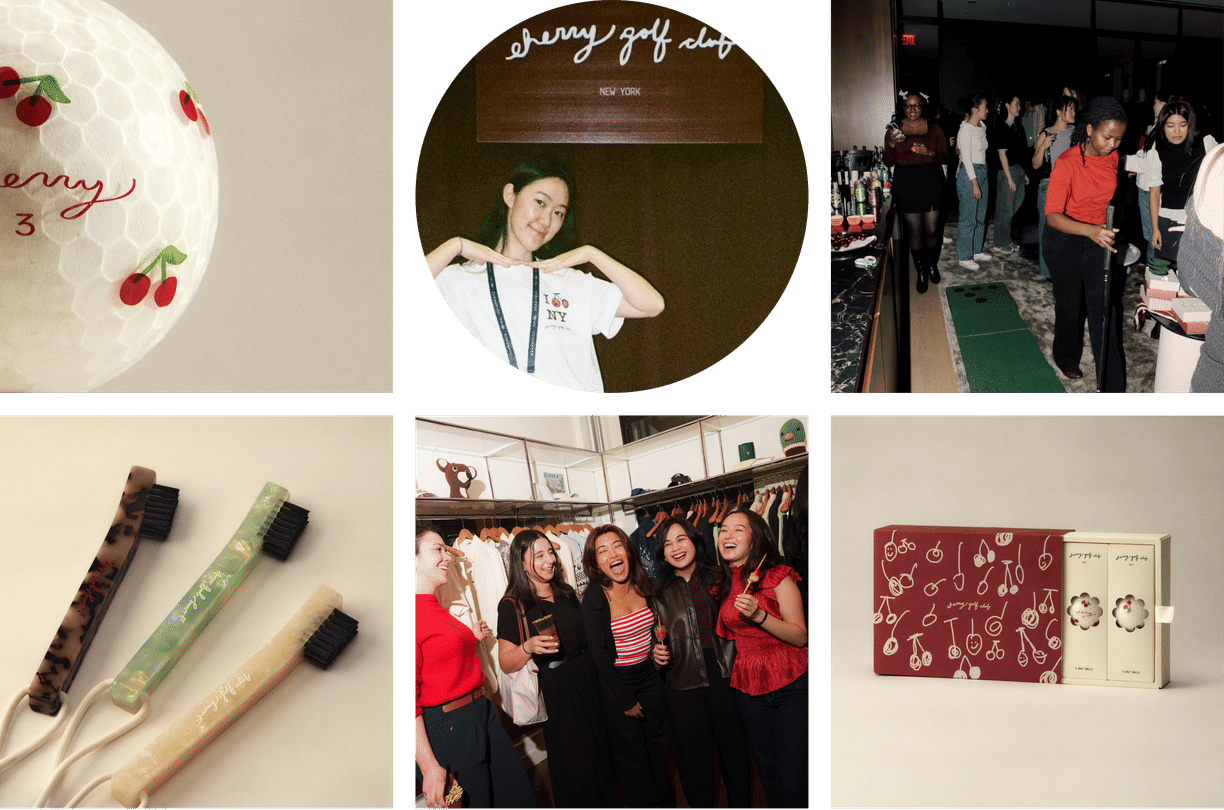
That August, Ivee hosted her first event. Word spread. Today, Cherry Golf Club has over 700 members in New York alone, women who show up weekly at the driving range, pack simulator socials 50 people deep, and compete in scramble tournaments. Some pick up a club for the first time at these events. Others are former collegiate players.
What struck Ivee wasn't just how many women came. It was how far they were willing to go.
"Girls were traveling over an hour just to get to the golf course together," she says. "Taking the subway every week."
The product
About three months into running events, Ivee started sketching a prototype for a golf ball, not from a corporate product brief, but as an idea she brought back to the group.
"I asked the girls: maybe we can all come up with something together," she says.
Members pitched their favorite golf ball colorways, voted on packaging design, and weighed in on product requests. A friend from the club volunteered to help with the illustrations and designs. The cherry motif, a nod to the club's name, made it onto the final box, with cutouts shaped like flowers. The text on the sleeves, typically reserved for performance specs, was replaced with quotes and language that reflected the community.
"Golf packaging is usually very standard," Ivee says. "Every single golf box follows the same format. We just ignored all those rules and rethought what a golf box could look like for a girl, something she'd actually love opening."
The first drop sold out within a day. A second batch went to pre-order. Since then, Cherry has expanded into gradient ball sets, tees, and brushes, each designed to break from category convention.
Why the brand model is different
Most consumer brands build a product, then try to layer community on top. Cherry did the opposite, and it shows. Members didn't just buy the golf balls. They pitched ideas throughout the process.
"All the girls have been there from the beginning," Ivee says. "They've seen every step. So when the final product came out, they were the biggest ambassadors."
That dynamic is hard to manufacture after the fact. It's also increasingly what younger consumers say they want from brands, genuine participation, not just a loyalty program.
Interest has since extended well beyond New York. Women in Asia, Australia, and Europe have reached out asking for Cherry events in their cities and products shipped to their doors.
What's next
Ivee's near-term goal: if a woman is brand new to golf, she should be able to find Cherry and have everything she needs to get started. That means expanding from accessories into full equipment, clubs, bags, all of it, plus events in new cities and potential collaborations with female-focused golf brands. The bigger ambition is simpler to state: build the golf brand that should have existed already.
“I wouldn’t be able to do any of this without the Cherry girls, my marketing and community lead Amelia and artist designer YooJin. And I wanted to thank the brands and communities that are helping the women’s space grow, like Known Girls, She Said Golf, and Fore the Ladies. Can’t wait to see what’s next for women in the golf space.”
"I would have never expected that one silly TikTok post would turn into a whole community," she says. "And now we're recognized around the world. It's very surreal."